Shoes for Swollen Feet: What Actually Fits
Daily Living Aids · Buying guide · 4 min read
Swelling changes the shape of a foot over the course of a day, not just its size. That is why buying the same shoe one size up usually fails: the extra room lands in the wrong place, the foot slides forward, and the shoe still presses where it hurt before.
Why a size up is the wrong fix
A shoe has a length, a width and a depth, and swelling mostly affects the last two. Going up a size adds length first. The result is a shoe that is loose at the heel, still tight across the instep, and now unstable to walk in, which is the opposite of what anyone wants.
What helps instead is a wider fitting in the same length, with enough depth over the top of the foot for the instep to rise without the shoe cutting in.
The four measurements that matter
Measure standing up, with weight on the foot, and measure both feet. Length is heel to longest toe. Width is the widest part across the ball of the foot. Instep girth is the tape passed over the top of the foot and under the arch, and it is the number most often ignored. Ankle girth matters if the swelling sits low around the ankle bone.
Write those four numbers down and shop against them. If a shoe lists only a size and no width fitting, it is a guess.
Fastenings: why straps usually win
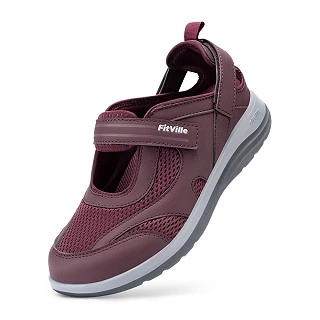
Laces set one tension and hold it. A wide hook-and-loop strap can be reset in seconds, so the same pair can be loose in the evening and snug in the morning without anyone getting on the floor to retie anything.
A strap that opens all the way back is also easier to get on and off, which matters if bending is difficult or if someone else is helping.
Try them on at the wrong time on purpose
Feet are usually at their largest in the late afternoon and evening. Fitting a shoe first thing in the morning is how people end up with a pair that only works for two hours a day.
Walk in them on a hard floor, not carpet. Check that the heel stays put, that no seam sits across a swollen area, and that the sole grips without catching on the floor as it lifts.
A short checklist before you buy
- A wide or extra-wide fitting rather than a longer size
- A seam-free or soft-lined toe box and instep
- An adjustable strap that opens fully, not laces
- A removable insole, so a prescribed orthotic can go in
- A flat, grippy outsole with a low heel
- A back that holds the heel firmly enough to walk in
What we stock for this
- EasyFit Wide-Width Comfort Shoes — wide fitting, adjustable strap, removable insole
- SteadyStep Adjustable Walking Cane — height-adjustable, for the first few days in new footwear
Read next
General information for a home setting, not medical advice. If a fall, a wound or a change in health is involved, speak to a doctor or an occupational therapist.


