Night Lighting That Actually Helps at 3am
Daily Living Aids · Home safety · 4 min read
The trip to the bathroom in the middle of the night is one of the most common moments a fall happens at home. Not because the route is difficult, but because it is done half asleep, in the dark, in a hurry, by someone who does not want to wake the house by switching a light on.
Why the ceiling light is the wrong answer
A bright overhead light at 3am does two unhelpful things. It dazzles eyes that have been dark-adapted for hours, so for several seconds you can see less than before you switched it on. And it wakes the brain up enough that going back to sleep afterwards becomes its own problem.
What is needed is much less light than people assume: enough to see the edge of the bed, the doorway, the corner and the toilet, placed low so it lights the floor rather than the face.
Light the route, not the room
Think of it as a path with four points: beside the bed, the bedroom doorway, any corner or turn in the hallway, and the bathroom itself. A small light at each of those points is far more useful than one bright light anywhere.
Low is better than high. A light at ankle or knee height shows you the floor, the threshold strip and anything that has been left in the way, which is what actually causes the trip.
Motion sensors, because nobody presses a switch
The reason plug-in night lights get bought and then not used is that they need a decision. A motion sensor removes the decision. The light is on before the feet reach the floor, and it goes off by itself a minute later so the room does not glow all night.
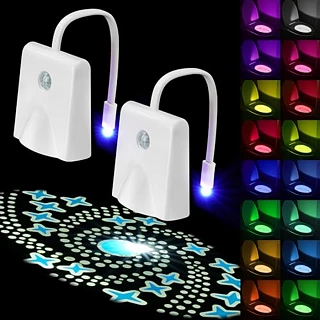
In a bathroom, a light that sits on the toilet itself solves the aiming and the seat-position problem at once, and it does it without lighting the whole room. It sounds like a novelty and it is one of the most genuinely useful things on this list.
Colour and brightness
Warm, dim light disturbs sleep less than cool white light. If the light has a brightness setting, set it lower than feels right during the day, then check it at night. Almost everyone sets these too bright the first time.
Avoid anything that flashes, cycles colours or has a bright standby indicator. In a dark bedroom a small blue LED can be genuinely annoying, and taping over it is not a design feature.
What to fix while you have the torch out
Walk the route in the dark yourself before you buy anything. Note every rug edge, trailing cable, door that swings, and piece of furniture with a hard corner. Half of the problem is usually solved by moving three objects.
If the night-time trips have become frequent, or if there is unsteadiness on the way, that is worth raising with a doctor rather than treating as a lighting problem alone.
Four places worth a light
- Beside the bed, low and on the side used to get up
- The bedroom doorway or threshold
- Any corner, turn or step in the hallway
- The bathroom, ideally lit at the toilet itself
What we stock for this
- NightGuide Motion Sensor Toilet Night Light — 2-pack, lights the toilet itself without lighting the room
- SafePath Motion Sensor Night Lights, 6-Pack — dimmable plug-ins for the doorway, hallway and corners
- GlowStep Motion Sensor LED Light Strip — rechargeable strip for a stair edge or under a bed frame
Read next
- Stairs: The Three Fixes That Matter Most
- Preventing Falls at Home
- Shoes for Swollen Feet: What Actually Fits
General information for a home setting, not medical advice. If a fall, a wound or a change in health is involved, speak to a doctor or an occupational therapist.
Want to see the products for every room in one place? Read Looking for Fall Prevention Products? Start Here, Room by Room.


