Reading and Hobbies When Your Eyes Tire
Health & Wellness · Everyday comfort · 4 min read
People rarely give up reading, sewing or model-making because they stopped enjoying it. They give it up because twenty minutes now costs a headache, and nobody has looked at the lighting since the room was decorated.
More light, closer, is usually the whole answer
A ceiling light is roughly the worst tool for close work. It sits behind the head, throws a shadow over the page and spreads its output across a whole room. A small light placed near the work, angled across it, can be ten times more effective at a fraction of the wattage.
Eyes need noticeably more light with age, and they also become less tolerant of glare, which is why a single very bright bulb overhead makes things worse rather than better. Aim for a well-lit page in a softly lit room, not a bright room.
Get the light off the ceiling and onto the page
A clip-on light on the headboard, the arm of a chair or the edge of a book solves this without rearranging furniture. Adjustable brightness matters more than maximum brightness: reading in bed and doing close needlework want very different settings, and a light with one setting will be wrong for one of them.
Warm light is easier on the eyes in the evening. Cooler light gives better contrast for fine detail during the day. A light that offers both earns its keep.
When magnification helps, and when it does not
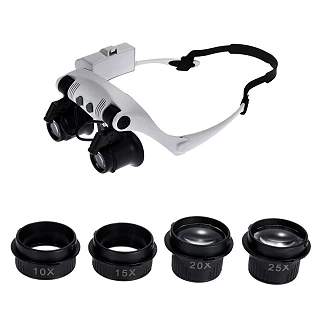
Magnifiers are for detail, not for compensating for a dim room. Sort the lighting first, then add magnification if the print or the stitch is still hard to resolve. A head-worn or stand magnifier keeps both hands free, which is the difference between reading a label and actually doing the hobby.
Interchangeable lenses are useful because different tasks want different strengths. Too much magnification narrows the field of view so much that reading becomes tiring in a new way.
Set the rest of the conditions
Sit with the work at a comfortable distance rather than bringing the head down to it, since neck strain ends a session as reliably as eye strain does. Break every twenty minutes and look at something across the room for twenty seconds.
Large-print editions and audiobooks are not a step down. Many people use all three depending on the day.
When to get eyes checked instead
Persistent eye strain, a change in how sharp things look, glare that has suddenly become worse, or straight lines that appear bent are reasons to book an eye examination rather than to buy a stronger magnifier. Sight changes with age are normal, but some of them are treatable, and some are more urgent than they feel.
A quick setup
- Put a light near the work, angled across it, not overhead
- Choose adjustable brightness over maximum brightness
- Warm light in the evening, cooler light for fine detail
- Sort the lighting before adding magnification
- Keep both hands free if the task needs two hands
- Look away across the room every twenty minutes
- Book an eye test if anything has changed recently
What we stock for this
- ClearView Hands-Free LED Head Magnifier — five lens strengths, built-in light, both hands free
- ReadEase Clip-On Reading Light — adjustable brightness, rechargeable, clips to a book or chair
- BrightSpace Motion Sensor Lights, 8-Pack — for the cupboards and corners a ceiling light never reaches
Read next
- Hearing Amplifier or Hearing Aid: The Honest Difference
- Sitting for Hours: Cushions and Pressure Relief
General information for a home setting, not medical advice. A magnifier or a reading light is not a treatment for any eye condition. If your sight has changed, book an eye examination with an optometrist.


